
Outcomes during Bruton tyrosine kinase inhibitor treatment for chronic lymphocytic leukemia: insights from remote therapeutic monitoring
1Texas Oncology, Houston, TX, USA; 2Canopy Care, Austin, TX, USA; 3BeOne Medicines Ltd., San Carlos, CA, USA; 4Snell Medical Communication, Montreal, QC, Canada; 5Oncology Hematology Care, Cincinnati, OH, USA
Background:
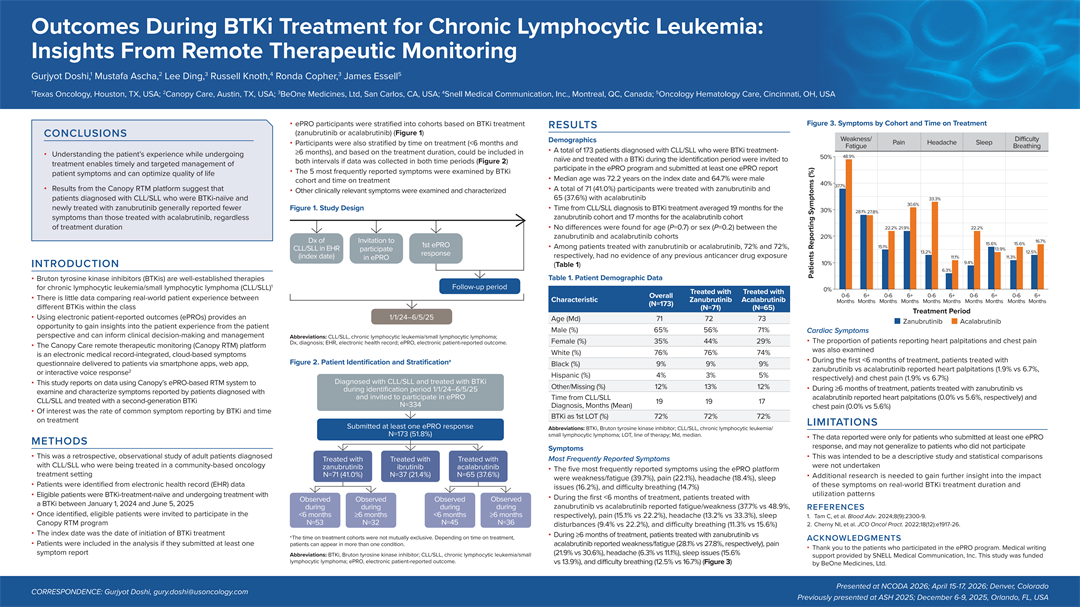
The second-generation Bruton tyrosine kinase inhibitors (BTKis), zanubrutinib and acalabrutinib, revolutionized treatment of the hematological cancers, including chronic lymphocytic leukemia and small lymphocytic lymphoma (CLL/SLL). As oral therapies designed for outpatient care, BTKis require ongoing attention to support adherence and monitor side effects.
Objectives:
Examine self-reported symptoms in patients diagnosed with CLL/SLL and undergoing treatment with a second-generation BTKi using the Canopy electronic patient reported outcome (ePRO)-based Remote Therapeutic Monitoring (RTM) system.
Methods:
This was a retrospective study of BTKi-treatment-naiive patients diagnosed with CLL/SLL and treated with a BTKi, between 1/1/2024 and 6/5/2025, in a United States of America (USA) community oncology setting. Patients, identified from electronic health records and invited to participate in ePRO using the RTM, were included if they submitted at least one ePRO report during treatment. The 5 most reported symptoms were examined by BTKi cohort and in two time periods: <6 months and ≥6 months of treatment.
Results:
Of 173 patients invited to participate, 71 (41.0%) were treated with zanubrutinib and 65 (37.6%) were treated with acalabrutinib (21.4% treated with the first generation BTKi ibrutinib were excluded from the analysis). Included patients’ median age was 72.2 years, and 64.7% were male. There were no differences in patient age (p=0.7), gender (p=0.2), or line of treatment (p=1.0) for zanubrutinib and acalabrutinib. Following BTKi treatment initiation, the five most reported symptoms were weakness/fatigue (39.7%), pain (22.1%), headache (18.4%), sleep issues (16.2%), and difficulty breathing (14.7%). For patients who submitted ePROs during the first six months of treatment, those receiving zanubrutinib versus (vs) acalabrutinib reported weakness/fatigue in 38% vs 49% of cases, pain in 15% vs 22%, headache in 13% vs 33%, sleep issues in 9% vs 22%, and difficulty breathing in 16% vs 11% of cases. For patients treated with zanubrutinib vs acalabrutinib for six months or longer, weakness/fatigue was reported in 28% vs 28% of cases, pain in 22% vs 31%, headache in 6% vs 11%, sleep issue in 16% vs. 14%, and difficulty breathing in 13% vs 17% of cases.
Conclusions:
Among patients diagnosed with CLL/SLL and treated with a second generation BTKi, those treated with zanubrutinib generally reported fewer symptoms than those treated with acalabrutinib, regardless of treatment duration. Study limitations include small sample size, patient self-selection, and lack of formal statistical analysis. ePROs from RTM allow for the understanding of the patient’s perspective while undergoing treatment and could enable timely and targeted management of symptoms.
Funding: BeOne Medicines Ltd.
Prior Presentations:
Presented at the American Society of Hematology (ASH) Annual Meeting 2025, December 6-9, Orlando, FL.
Send your feedback
Please do not include any personal information or details.
"*" indicates required fields
Was this page
helpful?
Send your feedback
Please do not include any personal information or details.
"*" indicates required fields