
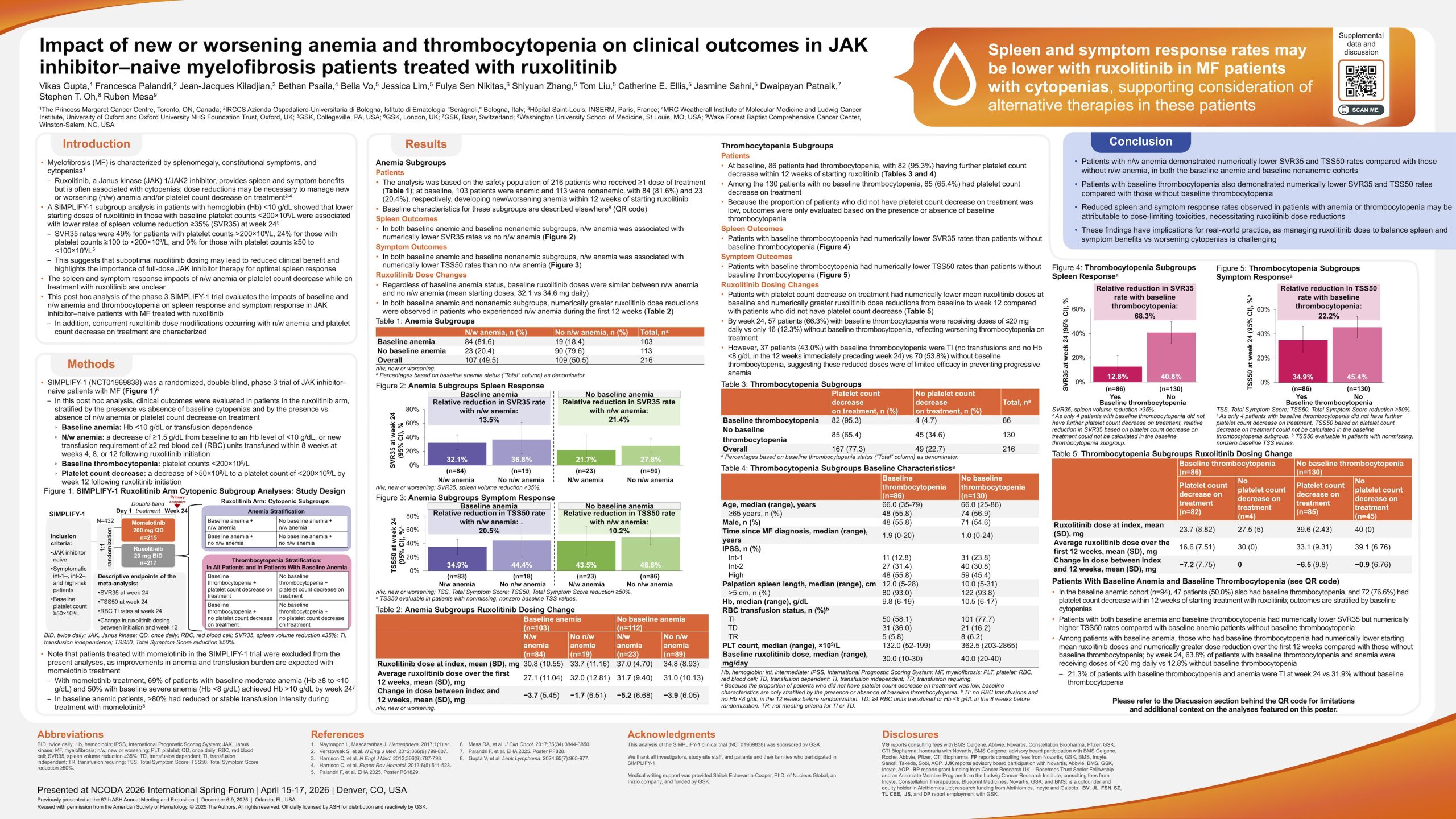
Clinical outcomes with ruxolitinib in Janus kinase inhibitor–naive patients with myelofibrosis and new or worsening anemia or thrombocytopenia: post hoc analysis of the phase 3 SIMPLIFY-1 trial
1The Princess Margaret Cancer Centre, Toronto, ON, Canada; 2IRCCS Azienda Ospedaliero-Universitaria di Bologna, Istituto di Ematologia “Ser.gnoli,” Bologna, Italy; 3 H.pital Saint-Louis, INSERM, Paris, France; 4MRC Weatherall Institute of Molecular Medicine and Ludwig Cancer Institute, University of Oxford and Oxford University NHS Foundation Trust, Oxford, UK; 5GSK, Collegeville, PA, USA; 6GSK, London, UK; 7GSK, Baar, Switzerland; 8Washington University School of Medicine, St Louis, MO, USA; 9Wake Forest Baptist Comprehensive Cancer Center, Winston-Salem, NC, USA
Background:
The Janus kinase (JAK) inhibitor ruxolitinib is associated with spleen and symptom benefits in patients with myelofibrosis but is often associated with cytopenias. In a previous subgroup analysis of the phase 3 SIMPLIFY-1 trial, lower starting doses of ruxolitinib led to lower spleen volume reduction ≥35% (SVR35) rates at week 24 in patients with hemoglobin <10 g/dL and platelet counts <200Å~10⁹/L, suggesting that ruxolitinib dose and outcomes may be negatively impacted in patients with cytopenias.
Objectives:
- Describe the impact of new or worsening anemia and thrombocytopenia on clinical outcomes in JAK inhibitor–naive patients with myelofibrosis.
Research Question:
To evaluate spleen and symptom responses and ruxolitinib dose reductions in patients with new or worsening (n/w) anemia or thrombocytopenia.
Methods:
The study design was a post hoc analysis of SIMPLIFY-1 (NCT01969838). In one analysis, ruxolitinib- treated patients (n=216) were stratified by the presence or absence of baseline anemia and n/w anemia within 12 weeks of starting treatment, as previously defined. In another analysis, ruxolitinib-treated patients were stratified by the presence or absence of baseline thrombocytopenia (platelet counts <200Å~10⁹/L) and n/w thrombocytopenia within 12 weeks of starting treatment (platelet count decrease >50Å~10⁹/L and platelet counts <200Å~10⁹/L). SVR35 and Total Symptom Score reduction ≥50% (TSS50) at week 24 were assessed; dose modifications of ruxolitinib by week 12 were also captured.
Results:
Among 103 baseline anemic and 113 baseline nonanemic patients, 84 (81.5%) and 23 (20.4%), respectively, developed n/w anemia. N/w anemia was associated with 13.5% and 21.4% relative reductions in SVR35 rates in baseline anemic and nonanemic patients, respectively. Similarly, there were 20.4% and 10.2% relative reductions in TSS50 rates in baseline anemic and nonanemic patients, respectively, with n/w anemia on treatment. While mean starting daily doses were comparable, mean reductions in daily dose by week 12 were greater in patients with versus (vs) without n/w anemia. A total of 86 patients (39.8%) had baseline thrombocytopenia, which was associated with relative SVR35 and TSS50 rate reductions of 69% and 24.4%, respectively, compared with baseline nonthrombocytopenic patients. Mean starting daily doses were lower in patients with baseline thrombocytopenia, and those with n/w thrombocytopenia on treatment had additional dose reductions by week 12.
Conclusions:
Anemia and thrombocytopenia are associated with reduced spleen and symptom response rates in ruxolitinib-treated patients, representing a real-world challenge in optimizing dosing to balance clinical benefit and worsening cytopenias. Earlier exploration of alternative treatment for patients with cytopenias and low ruxolitinib doses that compromise efficacy may be warranted.
Funding: GSK.
Prior Presentations:
Presented at the American Society of Hematology (ASH) Annual Meeting 2025, December 6-9, Orlando, FL.
Send your feedback
Please do not include any personal information or details.
"*" indicates required fields
Was this page
helpful?
Send your feedback
Please do not include any personal information or details.
"*" indicates required fields