

Montelukast prophylaxis for rituximab infusion-related reactions: a retrospective analysis
1Texas Oncology
Background:
In 2019, Texas Oncology (TXO) developed a premedication regimen for rituximab that included montelukast 10 mg administered orally 12 hours before, 30 minutes before, and 12 hours after cycle 1 day 1 (C1D1) rituximab infusions. This practice was based on a 2019 American Society of Clinical Oncology (ASCO) abstract reporting that montelukast premedication reduced the incidence and severity of infusion-related reactions (IRRs), infusion time, and the use of rescue medications in 87 adults with lymphoproliferative disorders treated at a single center. Adoption of the montelukast premedication regimen at TXO has been variable, prompting further evaluation to confirm or refute the findings presented in the 2019 ASCO abstract. A literature search was conducted and identified only case reports, with no additional comparative studies evaluating montelukast premedication for rituximab. Given the limited literature supporting montelukast as a premedication for rituximab, further investigation of its effectiveness in preventing IRRs is warranted.
Objectives:
- Describe the rationale for using montelukast as a premedication to reduce IRRs during initial rituximab administration.
- Explain the methodology and key findings of a retrospective chart review evaluating the impact of a montelukast premedication regimen on IRR incidence during initial rituximab infusions across TXO site.
- Assess the potential clinical implications of incorporating montelukast into standard rituximab premedication order sets to improve infusion safety and patient outcomes.
Research Question:
Among patients receiving an initial dose of rituximab, does use of a montelukast premedication regimen reduce the incidence of IRRs compared with patients who receive montelukast?
Study Design:
A retrospective chart review was conducted to determine the incidence of IRRs to initial rituximab infusions during the month of July 2025 in patients who were and were not prescribed a montelukast premedication regimen across all TXO sites.
Methods:
Medical record numbers were identified for all patients who received rituximab at any TXO site as part of a C1D1 regimen between July 1, 2025, and July 31, 2025. A retrospective chart review was used to exclude any of these patients that had previously received rituximab as part of a previous regimen. Electronic Medical Records of the remaining patients were reviewed to determine whether they had been prescribed a montelukast premedication regimen and whether they had experienced a reaction during their rituximab infusion. Incidences of IRRs were calculated and compared between patients receiving the montelukast premedication regimen and those receiving standard premedication alone.
Results:
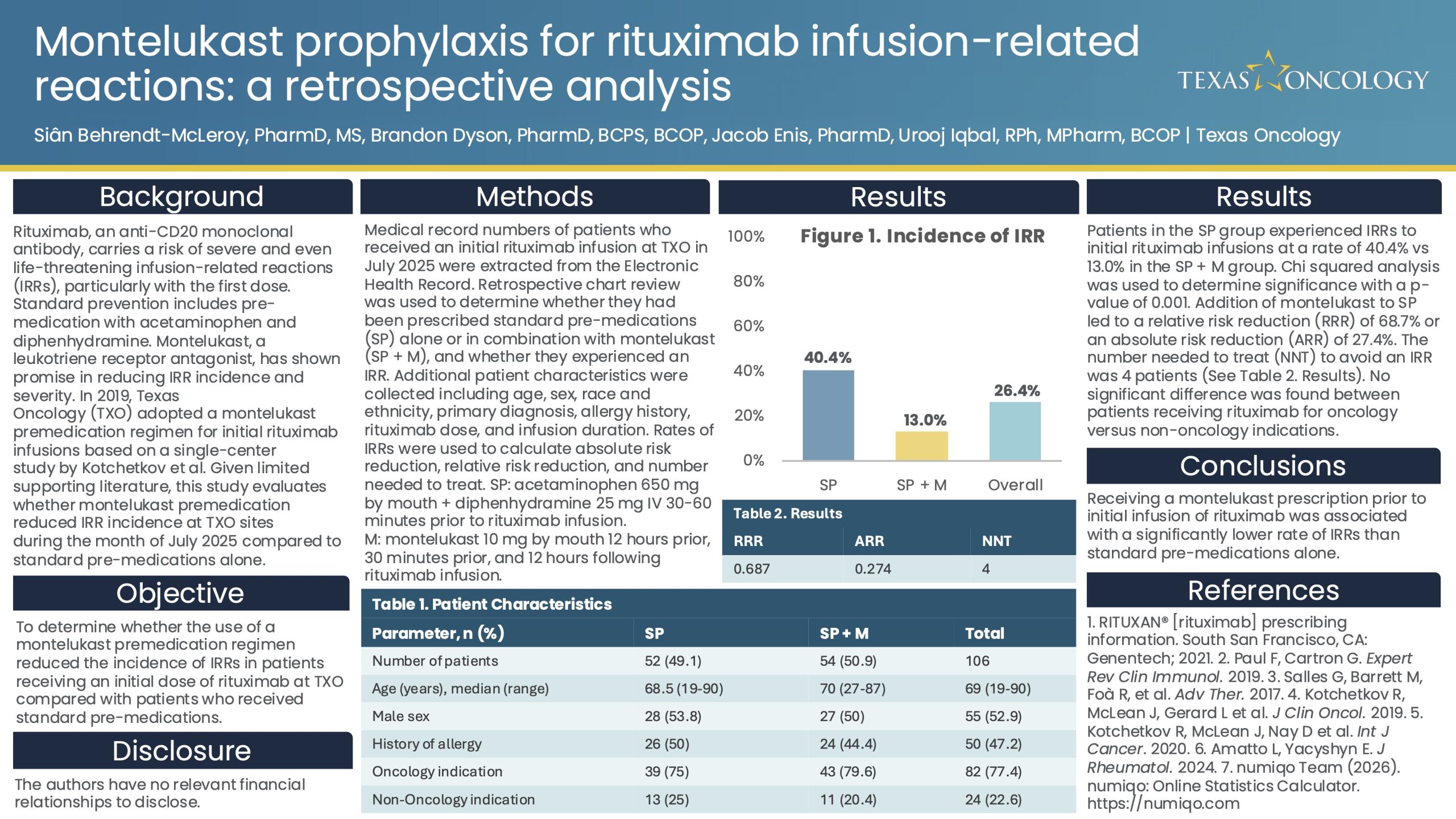
An analysis of 106 patients receiving their initial rituximab infusion at TXO in July 2025 showed an incidence of IRRs of 13.0% in the montelukast plus standard premedication group and 40.4% in the standard premedication alone group.
Conclusions:
A significant reduction in the incidence of IRRs to initial rituximab infusions suggests that TXO should incorporate the montelukast premedication regimen into order sets for regimens containing rituximab to reduce the incidence of IRRs in these patients.
Funding: Not applicable.
Send your feedback
Please do not include any personal information or details.
"*" indicates required fields
Was this page
helpful?
Send your feedback
Please do not include any personal information or details.
"*" indicates required fields