

Identifying opportunities for mesenchymal–epithelial transition factor biomarker testing and telisotuzumab vedotin treatment in nonsquamous non–small cell lung cancer: a retrospective review
1University of Florida College of Pharmacy, 2Cancer Specialists of North Florida
Background:
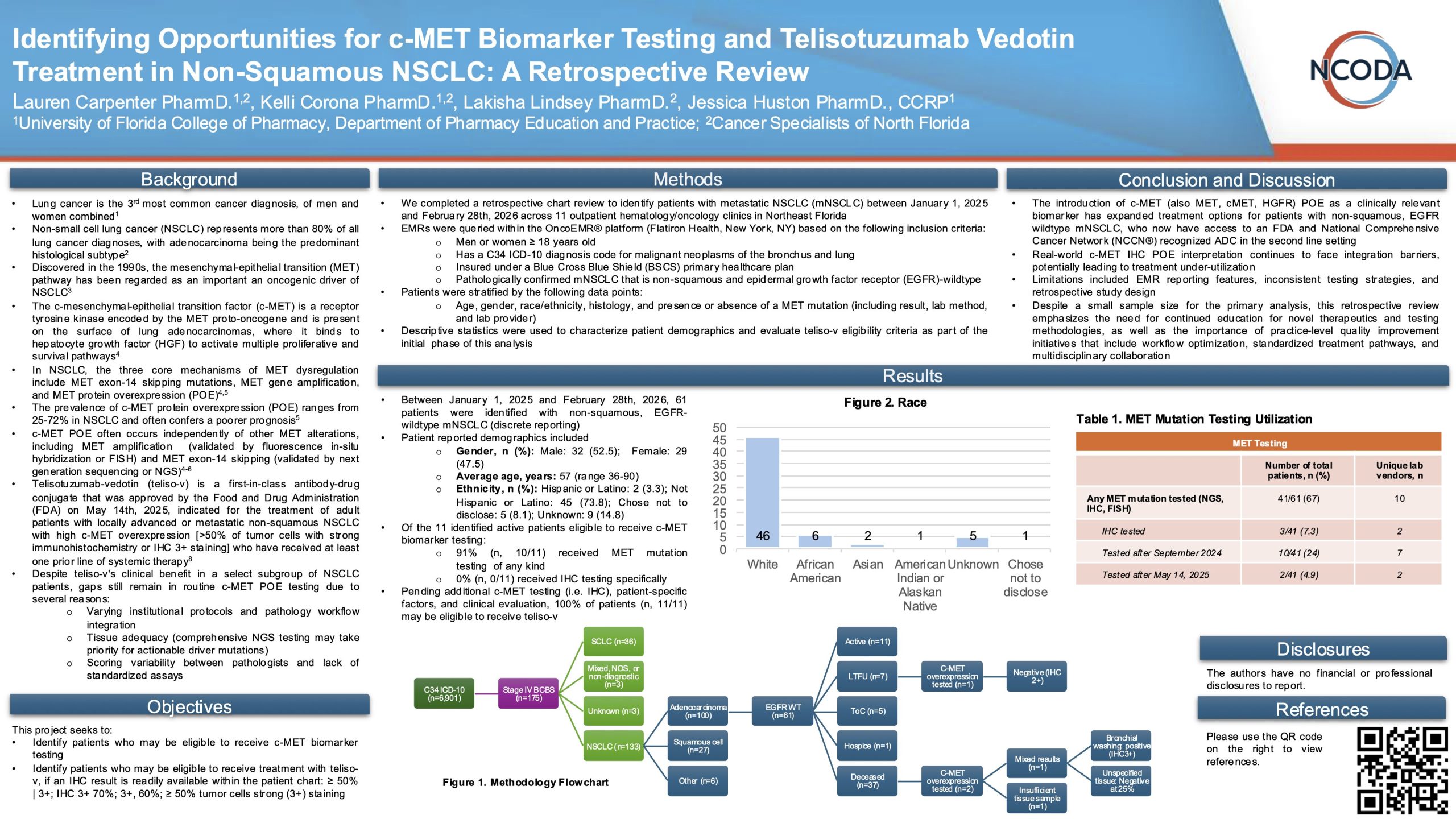
The mesenchymal-epithelial transition factor (MET) is a receptor tyrosine kinase encoded by the MET proto- oncogene and plays an important role in cellular growth and proliferation, serving as an oncogenic driver in non– small cell lung cancer (NSCLC). MET alterations are uniquely positioned as biomarkers that do not commonly overlap with other actionable genetic variants such as ROS1, BRAF, EGFR, and ALK. MET exon 14 skipping mutations, MET gene copy number (GCN) amplification, and MET protein overexpression play a vital role in biomarker-directed treatment decisions in patients with non-squamous NSCLC. In NSCLC, the prevalence of MET overexpression ranges from 25% to 39% and is associated with poorer prognosis. Telisotuzumab vedotin-tllv (Teliso-V) is a first-in-class antibody-drug conjugate approved by the United States Food and Drug Administration (FDA) in May 2025 for adult patients with locally advanced or metastatic non-squamous NSCLC with high MET overexpression (≥50% of tumor cells demonstrating strong immunohistochemistry [IHC] 3+ staining) who have received prior systemic therapy.
Objectives:
- Describe the role of MET alterations in NSCLC.
- Identify patients who may be appropriate candidates for MET biomarker testing.
- Evaluate the appropriateness of treatment with Teliso-V in eligible patients.
Methods:
A retrospective chart review is being conducted of patients with non-squamous, EGFR wild-type, locally advanced or metastatic NSCLC receiving active anticancer care within a large community oncology network between January 1, 2025, and February 28, 2026. Stratification variables include age, sex, race and ethnicity, histology, prior treatment history, hepatic function, MET expression status, and laboratory provider.
Results:
Data abstraction and analysis are ongoing, and results will be reported upon completion of the review.
Conclusions:
This ongoing review will evaluate opportunities for predictive MET biomarker testing and associated targeted therapy in patients with advanced non-squamous NSCLC in a community oncology setting.
Funding: Not applicable.
Send your feedback
Please do not include any personal information or details.
"*" indicates required fields
Was this page
helpful?
Send your feedback
Please do not include any personal information or details.
"*" indicates required fields